
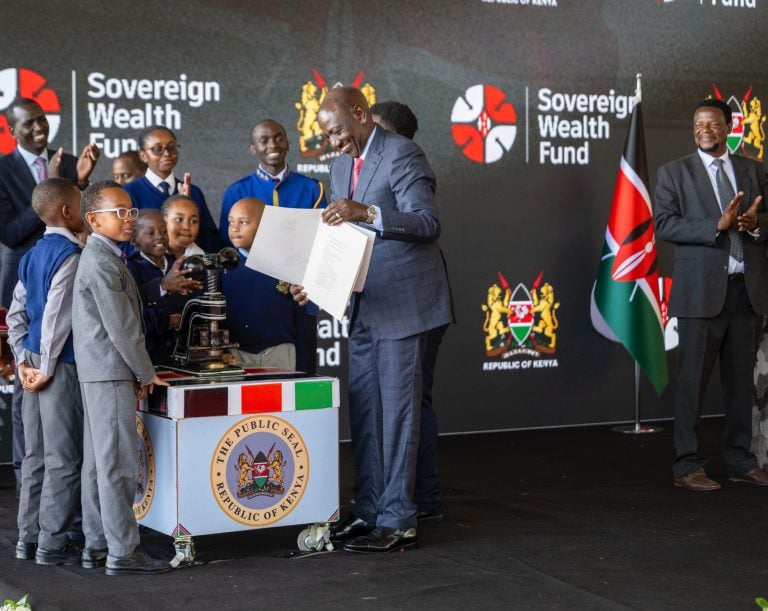
In a definitive move aimed at securing Kenya’s financial legacy, President William Ruto has officially assented to the Sovereign Wealth Fund Bill. The signing ceremony, held at State House on Wednesday, July 8, 2026, included an intentional symbolic touch: schoolchildren stood alongside the President to represent the law's core mission—safeguarding national wealth for the benefit of future generations.
After the signing, President Ruto and the children participated in the ceremonial sealing of the Act using the public seal. Chief of Staff and Head of the Public Service Felix Koskei hailed the enactment as a monumental milestone in Kenya’s economic transformation, calling it a strategic leap toward attaining first-world economic status.
Fund Mechanics: How It Works
The Kenya Sovereign Wealth Fund (KSWF) is projected to launch with an initial capitalization of Ksh200 billion. The operational guidelines prioritize asset insulation and structured distribution:
- Capital Sources: The fund will be built from natural resource revenues, government profits from petroleum operations, mining and oil royalties, and proceeds from the divestment of state interests in energy and mineral enterprises.
- Storage & Oversight: All monies will initially be deposited into a special holding account at the Central Bank of Kenya (CBK).
- Strict Financial Guardrails: To protect the integrity of the capital, the law explicitly prohibits the fund from lending money, granting credit, or being used as collateral for government borrowing.
The Three Pillars of the KSWF
The fund is structured into three distinct components designed to balance immediate economic stabilization with generational growth wealth:
| Component | Primary Purpose | Key Operational Rule |
|---|---|---|
| Stabilisation Component | Acts as a buffer to cushion the national economy during revenue fluctuations or unexpected financial shocks. | Only 50% of its investment income is reinvested back into it; the remaining 50% goes to the Urithi component. |
| Strategic Infrastructure Investment Component | Directs capital toward funding major national development, utility, and infrastructure projects. | Aimed at driving immediate structural capital growth and public utility. |
| Future Generation (Urithi) Component | Focuses on long-term savings built primarily from Kenya's non-renewable resources. | By law, a minimum of 10% of all fund allocations must be securely directed here. |
Key Revisions: What Changed from the 2019 Draft?
The finalized legislation introduces several pivotal shifts from its original 2019 iteration to ensure enhanced flexibility and macroeconomic integration:
- Expanded Revenue Streams: The law now explicitly captures proceeds from the sale or divestment of government stakes in petroleum and mining projects (such as potential future stake offloads in entities like the Kenya Pipeline Company).
- Currency Diversification: Decisions on holding foreign currency assets will now be made in direct consultation with the CBK rather than left solely to the Treasury's discretion—a strategic move to diversify Kenya's reserves beyond the US dollar.
- Removal of Rigid Allocations: The fixed percentage splits from the 2019 version have been scrapped. The Cabinet Secretary for the Treasury now has the seasonal flexibility to adjust allocations based on real-time economic conditions.
Public Debate and Criticism
Despite the government's optimism, the fund has faced notable pushback from political and economic commentators who question its timing given the country's fiscal pressures.
Justina Wamae, the former Roots Party presidential running mate, publicly challenged the initiative, arguing that Kenya has more immediate crises to solve.
"How do we set up a sovereign wealth fund when we keep running a budget deficit?" Wamae pointed out, noting that successful global wealth funds are built on structural budget surpluses and tightly managed natural resources.
Wamae stressed that with nearly half of Kenya’s ordinary revenue currently consumed by debt repayments and pensions, the nation should prioritize food sovereignty and debt stabilization before locking up precious liquid capital in long-term investments.


