
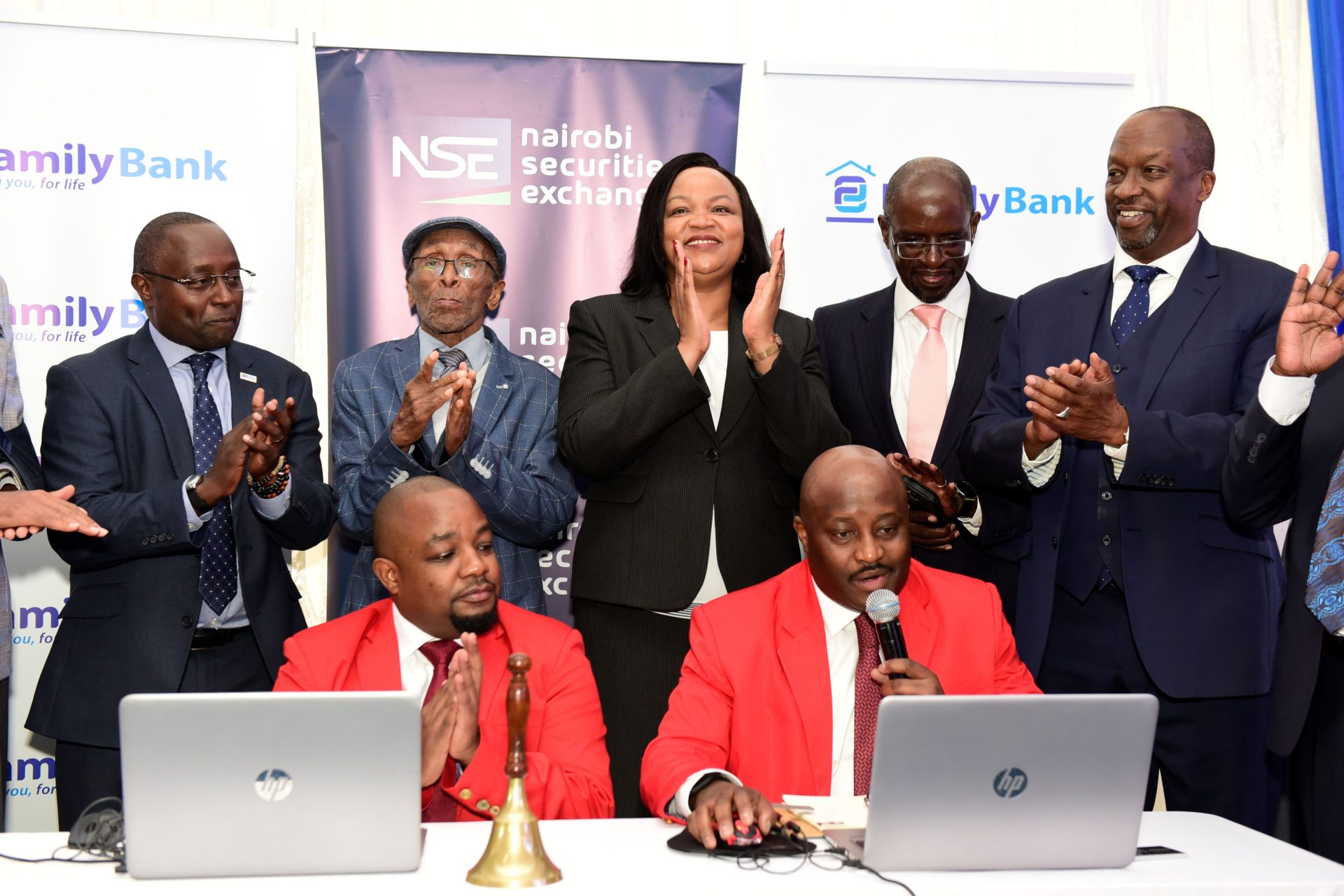
Family Bank has officially joined the Nairobi Securities Exchange (NSE), ringing the bell on June 23, 2026 to mark the largest private-sector listing on the Kenyan bourse in more than 17 years. The mid-tier lender introduced roughly 1.66 billion ordinary shares on the Main Investment Market Segment (MIMS) at a reference price of KSh 18.00 each, valuing the bank at about KSh 29.9 billion at the open.
This is not a conventional initial public offering. Family Bank listed by way of introduction, which means no new shares were issued and no fresh capital was raised. Instead, the shares already held by the bank's 6,345 existing owners, which have traded on the over-the-counter (OTC) market since 2006, simply moved onto the NSE's regulated platform, handing shareholders far greater liquidity and a transparent, market-driven price for the first time.
The deal at a glance
- Listing date: June 23, 2026
- Method: Listing by introduction (no new capital raised)
- Shares listed: approximately 1.66 billion ordinary shares
- Reference price: KSh 18.00 per share
- Implied market capitalisation: about KSh 29.9 billion
- Free float: roughly 572.7 million shares, or 34.5% of the register
- Segment: Main Investment Market Segment (MIMS)
- Advisers: Standard Investment Bank (lead transaction adviser), PwC (reporting accountant), Mboya Wangong'u & Waiyaki Advocates (legal counsel)
A deliberately low entry price
The most talked-about feature of the listing is its price. At KSh 18.00, the reference price sits well below the bank's own fundamentals. A blended independent valuation put fair value at around KSh 29.62 per share, leaving the listing price roughly 39% below that estimate. On a price-to-book basis, KSh 18.00 implies a multiple of about 0.86 times, against a book value of roughly KSh 20.91 per share as at March 2026, and below the 1.2-times-plus the stock fetched on the OTC market back in 2022 and 2023.
The discount looks even starker against recent OTC trading, where the shares had climbed about 33% over the six months to March 2026, averaging just over KSh 20 in their final full month before listing. The reading among market watchers is that the price was pitched to spur liquidity and broad participation rather than to extract maximum value, a sensible choice for a listing by introduction where the goal is active trading rather than a capital raise.
That logic appeared to play out on debut. The shares opened sharply above their KSh 18.00 reference, with Central Bank of Kenya Chairman Andrew Musangi noting that close to KSh 40 billion in wealth was created within minutes of trading, a striking move for a counter that valued the bank at under KSh 30 billion at the open.
The financials behind the listing
Family Bank entered the public market on a firm footing. Full-year net profit rose 55.4% in 2025 to about KSh 5.3 billion, up from KSh 3.46 billion the year before, and the momentum carried into 2026, with first-quarter after-tax profit climbing 52.6% to KSh 1.6 billion from KSh 1.0 billion a year earlier.
Shareholders' funds stood at KSh 34.77 billion as at March 2026, lifted in part by a 2025 private placement that raised KSh 8 billion against an initial KSh 6.09 billion target, exceeding it by 31%. The bank carries total assets of around KSh 230.3 billion. At the KSh 18.00 reference price, and assuming the dividend payout is held at the KSh 2.2 billion level seen in 2025, the stock offers an implied dividend yield of about 7.44%, an attractive figure for income-focused investors in the banking space.
The listing makes Family Bank the 12th banking counter on the NSE and slots it in as roughly the eleventh-largest listed lender by market value, just ahead of HF Group.
Four decades in the making
Family Bank's story stretches back to 1984, when Titus Kiondo Muya founded the Family Finance Building Society from a small Nairobi office with a starting loan of KSh 500,000. The society built its early base serving smallholder farmers before spreading its branch network nationwide. It secured a commercial banking licence from the Central Bank of Kenya in 2007, becoming Family Bank Limited, and went on to diversify into insurance and broaden its footprint, marking its 40th anniversary in 2024.
The shareholder register reflects that heritage. Kenya Tea Development Agency (KTDA) Holdings is the single largest shareholder with a stake of around 18.9%, followed by the estate of the late Rachael Njeri Muya at about 10%, the Muya-linked Daykio Plantations at 9.53%, and Titus Muya himself at roughly 4.4%.
The path to listing was not a straight line. The bank initially eyed a 2023 float but shelved it as market conditions soured, with NSE capitalisation sliding amid high inflation and a weakening shilling. The 2026 timing, set out in its 2025-2029 strategic roadmap, lined up with a far friendlier backdrop.
A revival for the Nairobi bourse
Family Bank's arrival is bigger than a single corporate milestone. It is the clearest sign yet that East Africa's long drought of new listings is ending. No company floated on the Kenyan, Ugandan, Tanzanian or Rwandan exchanges in all of 2025, making this part of a 2026 revival that began with the Kenya Pipeline Company (KPC) listing in March, the country's biggest IPO since Safaricom in 2008. That deal, a sale of a 65% stake in the state-owned firm, raised KSh 106.3 billion and was heavily oversubscribed.
The timing could hardly be better. The NSE has been on a tear in 2026, with its total market value crossing KSh 3 trillion for the first time and the All-Share Index up by double digits on the year, supported by easing inflation and a steadier shilling. For an exchange that has spent a decade short on new listings, a profitable, 40-year-old lender is exactly the kind of counter it has wanted to attract to rebuild confidence and deepen liquidity.
What to watch
For investors, a few questions will shape the months ahead:
- Does the discount close? With the reference price set well below fair-value estimates, the key question is whether sustained buying pulls the stock toward the KSh 29-30 fair-value range, or whether early enthusiasm fades once initial demand is satisfied.
- How does liquidity hold up? A listing by introduction lives or dies on trading activity. The stock barely changed hands on the OTC market, so the depth and consistency of NSE trading will be the real test of whether the listing delivered on its liquidity promise.
- Does the region follow? Exchanges in Uganda, Tanzania and Rwanda are watching Nairobi for proof that appetite for listings has returned. A strong Family Bank debut could nudge other private Kenyan firms, and regional peers, toward the public market.
For now, Family Bank's bell-ringing is a confident marker for a market finding its feet again. After a year of silence across East Africa's bourses, the listing adds another homegrown lender to the NSE and gives investors a fresh, income-friendly way to play Kenya's banking sector, with the market itself left to decide what the bank is really worth.
